Health & Boundaries: The Benefits and the Traps We All Fall Into
Ever wonder why some people bounce through life like they’ve got a battery pack strapped to their soul, while others feel like they’re dragging themselves through quicksand?
It’s not magic. It’s not caffeine.
It’s boundaries.
Yep—science shows that 9 out of 10 people who don’t set healthy boundaries feel constantly drained, overwhelmed, or resentful. Meanwhile, those who do? They get their life back. Their energy. Their peace. Their power.
But let’s be real—most of us weren’t taught how to protect our energy. We were taught to be nice. To not rock the boat. To be available 24/7.
And that’s exactly how we end up exhausted, overextended, and wondering why we feel so off.
Let’s break down what boundaries really are and why they matter if you want to stop living on empty.
💡What Are Boundaries (Really)?
Boundaries aren’t walls.
They’re guidelines. Standards.
Your way of saying, “Here’s what’s okay for me, and here’s what’s not.”
They’re the unspoken (and sometimes spoken) instructions for how you want to be treated—by others and by yourself. Without them? People guess. And spoiler alert: they usually guess wrong.
🚨 Why Boundaries Are the Secret to Feeling Like You Again
1. 🧠 Mental Health = Protected
No boundaries = constant anxiety, stress, and feeling like everyone’s needs come before yours.
Strong boundaries = better sleep, more peace, less overwhelm. You’re not meant to be everything for everyone.
In fact, people who practice boundary-setting report a 42% drop in burnout in just three months. That’s not a little thing—that’s a lifeline.
2. ❤️ Your Relationships Get Better, Not Worse
Boundaries don’t push people away.
They invite the right people in.
The ones who respect your time, energy, and truth.
You stop performing for approval.
You stop bottling resentment.
You start showing up fully—because you’re not secretly exhausted or pissed off.
“The most compassionate people are the most boundaried.” —Brené Brown
(And she knows her stuff.)
3. 🔋 You Stop Leaking Energy Like a Broken Hose

Your energy is sacred. And it’s not unlimited.
But let’s be honest—we live like it is.
Every time you say yes when your gut is screaming no, you leak a little more life force.
That’s not selfless. That’s self-sabotage.
Boundaries are how you stop bleeding energy and start directing it toward what actually matters:
- 🔍 Deep, uninterrupted focus
- 🤝 Joyful, mutual connections
- ✅ Finishing what you start (without 20 tabs open in your brain)
- 💤 Rest that refuels instead of numbs you out
When you stop scattering yourself in a thousand directions, you reclaim the power to move with clarity, purpose, and peace.
4. 🧬 Your Body Will Thank You
Your body isn’t just along for the ride — it’s keeping the receipts.
Every time you override your limits, bite your tongue, or say “yes” out of guilt?
Your nervous system logs it. Your immune system feels it. Your body remembers.
Here’s what happens when boundaries are blurry:
- Stress skyrockets. (Hello, inflammation and burnout.)
- Cortisol—the stress hormone—stays elevated like a red alert that never shuts off.
- Your sleep suffers. Your digestion tanks. Your energy flatlines.
- The “yeses” you didn’t mean turn into chronic fatigue, headaches, tension, and illness.
Boundaries aren’t just emotional self-care—they’re physical protection.
Saying “no” when you mean it is a health practice.
Making space for rest, real meals, and movement? That’s medicine.
So if you’ve been ignoring your body’s whispers…
This is your loving wake-up call: your body knows when your boundaries are being crossed—even if your mind tries to explain it away.
🚧 The 5 Boundary Traps That Sneak In and Wipe You Out (And What to Do Instead)
Trap #1: The People-Pleaser Loop
"If I say no, they’ll be disappointed. And I can’t handle that."
Sound familiar?
You say yes even though you're exhausted. You offer help before it's asked. You rearrange your needs so someone else can stay comfortable.
At first, it feels like you're being kind. But over time?
You start disappearing.
You’re constantly giving… but not receiving.
And eventually, you’re resentful, drained, and wondering, “Why does no one show up for me the way I show up for them?”
The truth? People-pleasing is fear dressed up as kindness.
And it attracts the kind of people who are happy to take advantage of that.
👉 The shift: Start saying no in small, low-risk moments. Practice with people you trust. Watch how respect grows, not shrinks, when you honor yourself.
Trap #2: The Guilt-Shame Spiral
"If I set boundaries, I’m selfish. I’m mean. I’m a bad daughter, friend, partner…"
Oof. That inner critic is loud, isn’t she?
Most of us were raised to believe that good people bend, stretch, and sacrifice. That putting yourself first is wrong.
So when you do try to set a boundary? The guilt kicks in fast and furious.
- You over-apologize.
- You backpedal.
- You feel like a jerk for saying, “I can’t.”
- You wonder if your needs are even valid.
Here’s the real talk: Boundaries are not rejection. They're direction.
You’re not turning your back on people. You’re showing them how to have a real, healthy relationship with you.
👉 The shift: Remind yourself: “Boundaries aren’t selfish. They’re self-respect in action.” And people who truly care about you will want you healthy, not depleted.
Trap #3: The All-or-Nothing Overcorrection

"I tried setting boundaries once. It backfired. So now I just don’t bother."
This one shows up after years of being boundary-less…
You finally hit your breaking point and lay down a hard boundary like it’s the Berlin Wall. But because you’re not used to it—or because someone pushes back—you panic. You either ghost or give in.
And then you tell yourself: “See? Boundaries don’t work.”
What’s really happening? You went from zero to 100 without the in-between. Boundary-setting is a skill—not a one-and-done moment.
👉 The shift: Start small. Let it be messy. Expect some pushback. That doesn’t mean you’re doing it wrong—it means you’re finally doing something different.
Trap #4: The Mind-Reader Myth
"They should just know better."
You ever find yourself getting mad… but you didn’t actually tell the person what bothered you?
Yep. That’s this trap.
- You drop hints.
- You stew in silence.
- You get hurt when they “should’ve known.”
But the truth is—they can’t read your mind. And you’re not weak for needing to say things out loud.
Unspoken boundaries are like invisible fences… that no one else can see.
👉 The shift: Communicate clearly. Kindly. Directly. “I need quiet time from 8–10,” hits different than “Ugh, I’m just so tired of being interrupted.” People aren't ignoring you—they’re just not getting the full picture.
Trap #5: The Digital Drain Trap
"I just need to answer this one last message…"
Ah, the 24/7 pressure cooker.
You’ve got emails pinging at dinner. DMs at 11PM. Notifications yanking your attention every five seconds. The pressure to always be on is real—and exhausting.
You feel guilty if you don't respond immediately.
You keep working past your capacity because you can.
And before you know it, your phone becomes your boss.
But here’s the thing:
You don’t owe the internet constant access to your nervous system.
👉 The shift: Create digital boundaries that protect your peace.
- Phone off after 8.
- No notifications during meals.
- Auto-responders that say: “I’ll get back to you within 24 hours.”
Reclaim your time. You’re not a machine.
Bottom line?
Boundary traps are sneaky, but they lose their power the moment you name them and start choosing differently. And that choice? It’s available to you right now.
⚠️ Signs Your Boundaries Need Reinforcement
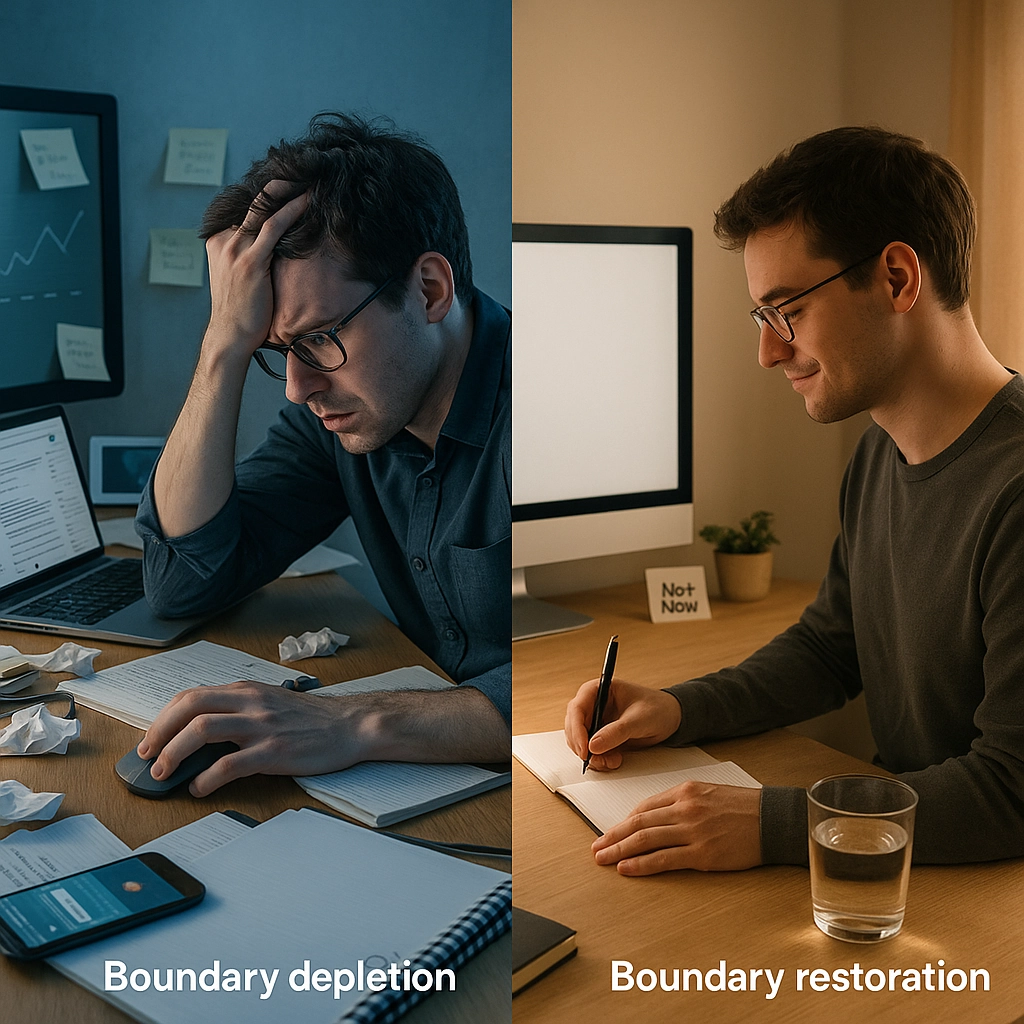
⚠️ Signs Your Boundaries Need Reinforcement
The Boundary-Setting Process: A Simple Framework
Setting boundaries doesn't have to be complicated. Here's a four-step process:
- Identify: Pay attention to situations that leave you feeling drained, resentful, or uncomfortable. These are boundary red flags.
- Clarify: Get specific about what needs to change. "I need uninterrupted focus time from 9-11 AM" is clearer than "I need more space."
- Communicate: Express your boundary directly and without over-explaining. "I don't check email after 6 PM" is stronger than "I'm trying not to check email after 6 PM if that's okay."
- Enforce: Boundaries without consequences aren't boundaries—they're suggestions. Decide in advance how you'll respond to violations.
💥 The Truth? Boundaries = Self-Respect
💥 The Truth? Boundaries = Self-Respect
Let’s call it like it is:
You can’t live a powerful, grounded, soul-led life while constantly betraying your own needs.
Every time you silence your “no” to avoid conflict…
Every time you push through exhaustion to prove your worth…
Every time you prioritize someone else’s comfort over your truth…
You’re not keeping the peace—you’re keeping yourself small.
Boundaries are not walls. They are declarations.
They say:
- “I matter.”
- “My needs are valid.”
- “I trust myself enough to honor what feels right.”
This isn’t about cutting people off.
It’s about no longer cutting yourself off from you.
And if you’re feeling the nudge right now—the one that says “I need to change this, but I don’t know how”…
That’s your invitation.
🔥 The Unshakable Boundaries Pathway is where you begin.
This isn’t fluff. It’s not performative self-care.
It’s deep, real boundary work rooted in reclaiming your energy, your voice, and your power—without guilt.
Because setting boundaries isn’t selfish. It’s how you come home to yourself.
✨ Join the priority waitlist now — only 10 VIP spots available.
Let’s get your power back.

You must be logged in to post a comment.